
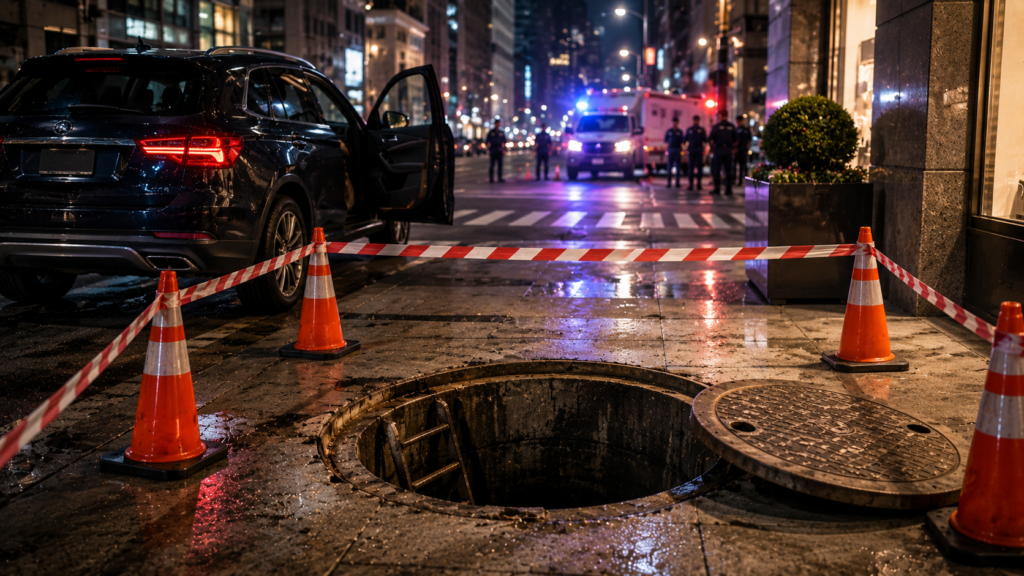
A 56-year-old woman died after falling into an uncovered maintenance hole in Midtown Manhattan, raising urgent questions about public safety, street maintenance, and how a dangerous opening was left exposed on one of New York City’s busiest commercial corridors.
The incident happened late Monday night near Fifth Avenue and East 52nd Street. According to police, the woman had parked her Mercedes-Benz SUV near the maintenance hole and fell in shortly after getting out of the vehicle. Emergency responders found her unconscious at the bottom of the opening, and she was later pronounced dead at NewYork-Presbyterian/Weill Cornell Medical Center.
The maintenance hole was linked to Con Edison, the utility company that operates major underground infrastructure across New York City. Con Edison said it was actively investigating the accident and expressed condolences to the woman’s family. Police are also investigating the circumstances, while the city’s medical examiner is expected to determine the official cause of death.
The case has shocked many New Yorkers because of where it happened. Fifth Avenue in Midtown is one of the city’s most visible and heavily traveled areas, lined with luxury stores, offices, hotels, and constant pedestrian traffic. An uncovered maintenance hole in such a location represents a serious safety concern, especially at night when visibility may be limited.
Reports said the woman fell roughly 10 feet into the opening. Officials have not yet confirmed why the cover was missing or whether any warning signs, barriers, or active work crews were present at the time. Gothamist reported that the cover was later found about 15 feet away from the opening and that officials said no construction was taking place at the intersection when the incident occurred.
The tragedy highlights a broader issue in New York: the risks created by underground utility systems that operate beneath some of the busiest streets in the world. Manholes and maintenance covers are part of the city’s daily infrastructure, but when they are unsecured, displaced, or left open, they can become deadly hazards within seconds.
For pedestrians, the danger is especially severe because maintenance holes can be difficult to see in crowded or dimly lit areas. A person stepping out of a vehicle may not notice an opening directly beside them, particularly if the street is busy or if the hole is not surrounded by visible barriers.
The investigation is likely to focus on several key questions: who last accessed the maintenance hole, when the cover was removed, whether safety procedures were followed, and why the opening was not secured before the public could approach it. These answers will be critical for the woman’s family and for public confidence in the safety of city streets.
The death also places renewed attention on utility accountability. In a city as dense as New York, companies responsible for underground infrastructure must ensure that maintenance areas are clearly marked, covered, or blocked off. Even a short lapse can place pedestrians, drivers, and workers at serious risk.
For now, the incident remains under investigation. But the central concern is already clear: a routine city sidewalk and street environment became fatal because a basic layer of protection was missing. The death of a woman on Fifth Avenue is not only a tragic accident; it is a warning about the importance of strict safety controls around urban infrastructure.