
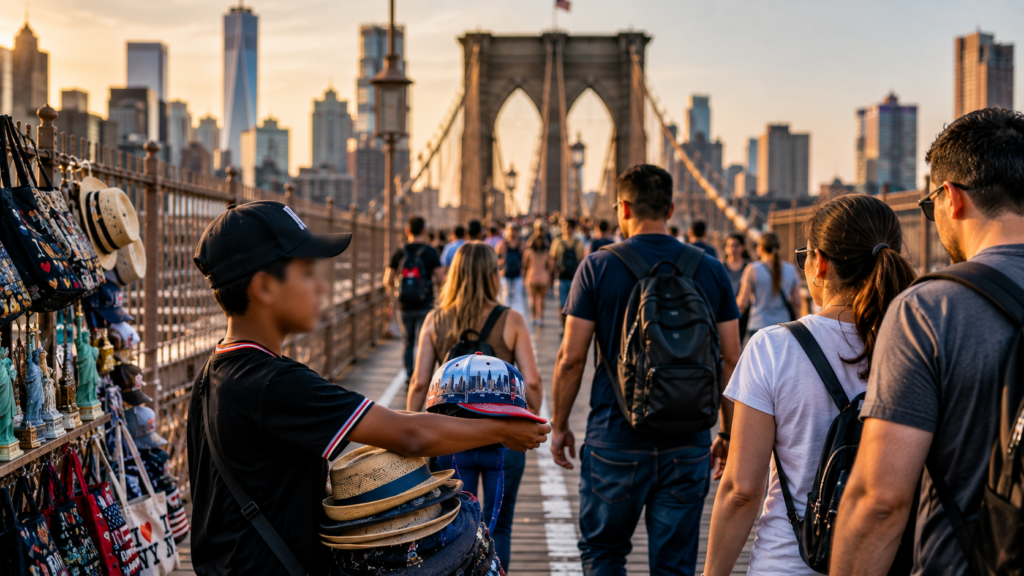
The growing presence of unlicensed vendors on the Brooklyn Bridge is renewing debate in New York City over enforcement, pedestrian safety and the use of children to sell goods at one of the city’s busiest tourist landmarks.
Recent local reporting found dozens of vendors selling items including fruit, bottled water, hats, souvenirs and New York-themed merchandise along the bridge. The New York Post counted about 42 vendors during a recent visit, despite city rules prohibiting vending on the pedestrian and bicycle areas of city-owned bridges.
The controversy has intensified because children are among those selling goods. Reporters encountered vendors as young as 11 and 12, with some working alongside relatives and others appearing to manage sales temporarily on their own. One 11-year-old boy told the newspaper that he could earn between $100 and $300 per day while his mother sold merchandise nearby.
Their presence has raised questions about child welfare and safety, particularly given the enormous number of pedestrians who cross the bridge and the long hours some young vendors reportedly spend working there. At the same time, the families involved may be relying on informal vending as a source of income, adding a socioeconomic dimension to the enforcement debate.
The dispute also involves licensed merchants. Some vendors, including disabled military veterans with vending credentials, say unauthorized sellers are undermining their businesses while enforcement is inconsistent. One licensed veteran told reporters that legitimate vendors can face restrictions even as unlicensed sellers continue operating nearby.
The situation is particularly sensitive because the Brooklyn Bridge is both critical transportation infrastructure and one of New York City’s most recognizable tourist destinations. Concerns about congestion were a major reason the city adopted rules in 2024 prohibiting vending on elevated pedestrian walkways and bicycle lanes on bridges. Public comments submitted during the rulemaking process repeatedly cited overcrowding, emergency access and the visitor experience.
The city has confronted the problem before. Vendors were removed from the Brooklyn Bridge in early 2024, with some subsequently relocating to nearby DUMBO, where authorities also carried out enforcement actions following complaints about sidewalk congestion.
The latest resurgence shows how difficult the issue remains. Authorities must balance enforcement of existing rules and protection of pedestrian space with the economic realities facing informal vendors.
For New York City, the challenge now extends beyond simply deciding whether vendors should remain on the bridge. The controversy has become a broader debate over fair enforcement, children’s safety, the livelihoods of licensed merchants and how one of America’s most famous landmarks should function for residents and millions of visitors.