






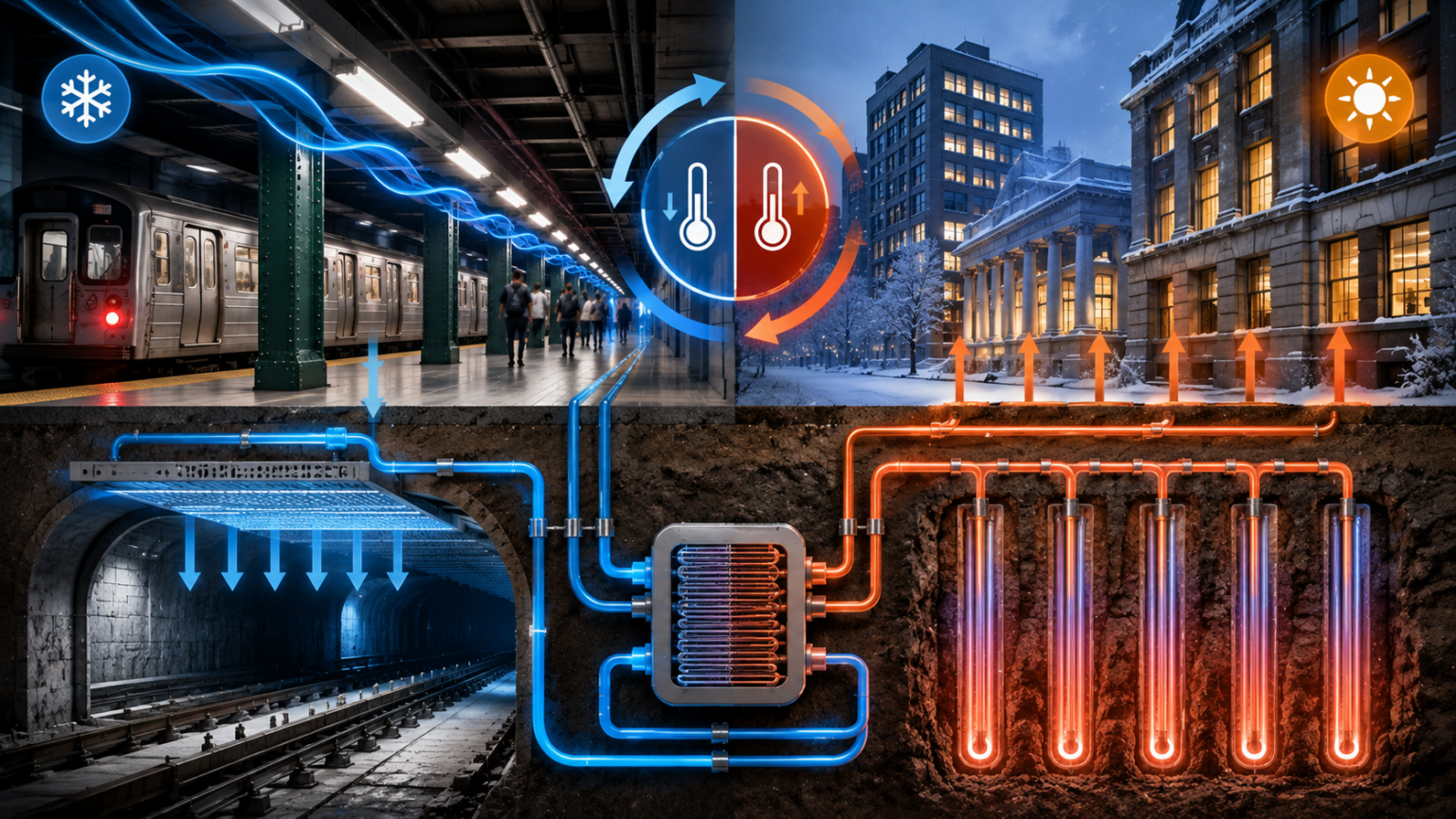
New York officials are exploring an ambitious new approach to one of the subway system’s most persistent summer problems: extreme heat on underground platforms. The proposal would use a thermal energy network to remove heat from subway stations and eventually reuse that energy to warm nearby municipal buildings during the winter.
Mayor Zohran Mamdani, Governor Kathy Hochul and the Metropolitan Transportation Authority announced the initiative this week, beginning with an approximately $800,000 feasibility study focused on the interconnected Brooklyn Bridge–City Hall 4/5/6 and Chambers Street J/Z stations in Lower Manhattan.
The location was chosen in part because of its notoriously high temperatures. According to the MTA, Brooklyn Bridge–City Hall recorded an average summer platform temperature of about 96°F, or roughly 36°C, in 2025, making it one of the hottest stations in the subway network.
Rather than relying on conventional air conditioning, the proposed system would attempt to capture the heat already accumulating underground.
Under the preliminary concept, radiant cooling technology would absorb heat from the Brooklyn Bridge–City Hall platforms and potentially Chambers Street. Pipes would then carry that thermal energy to geothermal boreholes drilled beneath the unused center platform at Chambers Street, where heat could be stored underground.
During colder months, the system could effectively work in reverse, allowing stored thermal energy to help heat nearby municipal buildings instead of letting the subway’s excess summer heat go to waste. Officials are considering buildings around the Civic Center area as potential beneficiaries of the network.
If ultimately constructed, officials say it would become the first thermal energy network incorporated into a U.S. transit system. Similar thermal and geothermal systems are already operating at other large facilities in New York, but adapting the concept to an active, century-old subway network would present a significantly different engineering challenge.
The feasibility study will examine whether the technology can meaningfully reduce platform temperatures, how much thermal energy could be captured and reused, and whether installing the necessary infrastructure is technically and financially practical. The project is also being coordinated with a broader planned overhaul of the aging Chambers Street station.
The idea comes as New York faces increasingly uncomfortable summer conditions underground. Heat generated by trains, braking systems, electrical equipment and other infrastructure can become trapped inside older stations, sometimes leaving platforms considerably hotter than conditions at street level.
For commuters, the potential benefit is straightforward: cooler platforms during New York’s hottest months. But officials see a broader opportunity to turn a longstanding transit problem into an energy resource.
If the Lower Manhattan study demonstrates that the system is practical, the concept could provide a model for tackling extreme heat elsewhere in the subway network — transforming heat that currently makes summer travel miserable into energy that can be captured, stored and put back to work during New York’s winters.