
New York officials are exploring a new approach to one of the city’s most persistent summer problems: extreme heat inside subway stations. The initiative would examine technologies capable of reducing underground temperatures while potentially capturing and reusing heat produced by the transit system.
The plan brings together the administration of New York City Mayor Zohran Mamdani, New York Governor Kathy Hochul, and the Metropolitan Transportation Authority (MTA) as officials look for longer-term solutions to increasingly uncomfortable and potentially dangerous conditions across the subway network.
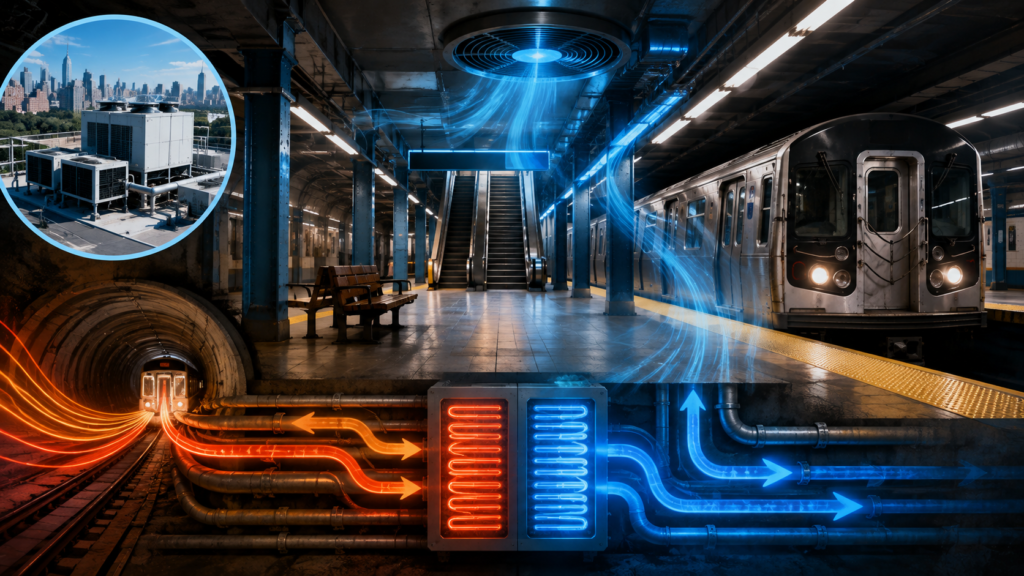
At the center of the proposal is a study examining the feasibility of a thermal energy network connected to transit infrastructure. Such a system could capture heat generated underground by trains, electrical equipment and other subway operations and redirect that energy for useful purposes rather than allowing it to accumulate inside stations.
New York’s subway system presents an unusual cooling challenge. Many stations were constructed decades before modern air-conditioning systems became standard, while trains, braking systems, electrical equipment and crowded platforms can generate additional heat underground. During periods of extreme summer weather, temperatures on some platforms can become significantly hotter than conditions at street level.
Officials are therefore looking beyond conventional air conditioning, which would be difficult and expensive to install throughout the vast subway network. The thermal-energy concept could provide another option by treating excess underground heat as an energy resource that can potentially be captured, transferred and reused.
The initiative comes as New York faces growing pressure to adapt its transportation infrastructure to more frequent periods of extreme heat. High temperatures can affect not only passenger comfort but also public health, particularly for older residents, children and people with underlying health vulnerabilities.
Any large-scale implementation, however, would require extensive technical and financial analysis. Engineers would need to determine which stations are suitable, how much heat could realistically be removed, where captured energy could be used and whether the system could operate efficiently within the city’s complex underground infrastructure.
For now, the project remains in the study stage rather than representing an immediate citywide cooling program. But if the concept proves technically and economically viable, it could offer New York a new way to address subway heat while simultaneously turning energy currently trapped underground into a potentially useful resource.
The study could ultimately become part of a broader effort to modernize the city’s century-old transit infrastructure and prepare the subway system for hotter summers in the decades ahead.