
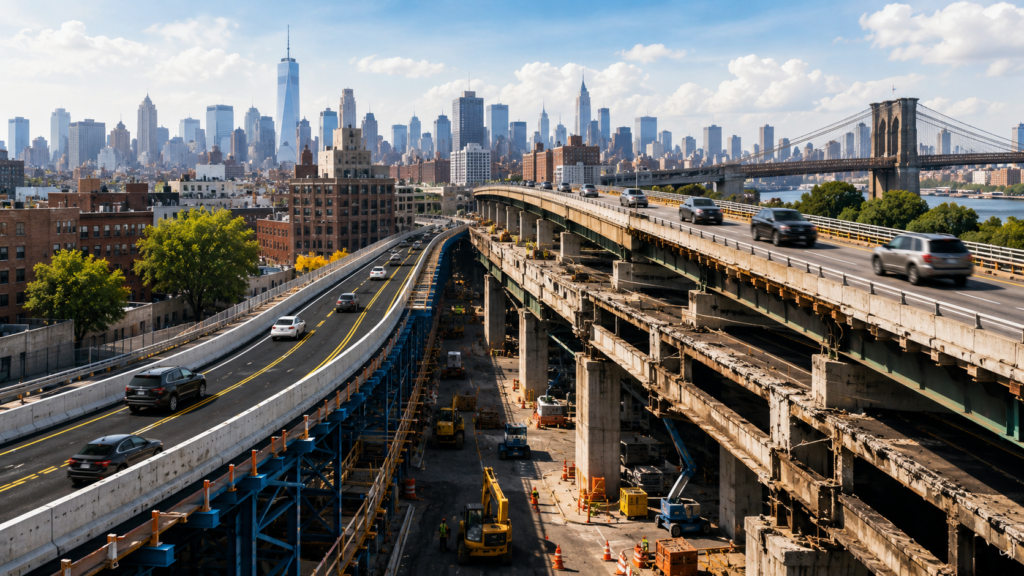
New York City has unveiled a $4 billion plan to rehabilitate a deteriorating section of the Brooklyn-Queens Expressway, launching one of the city’s most ambitious infrastructure projects after decades of debate over the aging highway.
Mayor Zohran Mamdani and the New York City Department of Transportation announced that the project will focus on the city-owned BQE Central, a roughly 1.5-mile section running between Atlantic Avenue and Sands Street in Brooklyn. The corridor includes the well-known triple-cantilever structure beneath the Brooklyn Heights Promenade.
City officials say the infrastructure is approximately 20 years beyond its original design life and now carries about 130,000 vehicles every day, more than twice the traffic volume it was designed to accommodate. Officials have warned that continued deterioration could eventually force closures and send large numbers of cars and trucks onto surrounding Brooklyn streets.
A central feature of the proposal is the construction of temporary bypass highways that would allow traffic to continue moving while the existing structure undergoes major repairs.
One temporary two-level roadway would be built along Furman Street below the Brooklyn Heights Promenade, running from Atlantic Avenue to Columbia Heights. Another elevated bypass would carry traffic from Columbia Heights across the Brooklyn Bridge approach toward the Manhattan Bridge.
The strategy is designed to prevent tens of thousands of vehicles from being diverted through residential neighborhoods during construction while also avoiding the complete closure of the Brooklyn Heights Promenade — one of the most controversial elements of previous proposals.
Beyond structural repairs, the project would address deteriorating concrete and the triple cantilever while upgrading drainage, railings and lighting. Once completed, city officials estimate the work could extend the useful life of BQE Central by approximately 40 years.
Construction is expected to begin around 2030 and take approximately a decade, with the city beginning its environmental review process this fall. An environmental impact statement is currently expected in summer 2028.
However, the proposal is already generating debate. Some community and transportation advocates argue that spending billions to rehabilitate the highway preserves an outdated model of urban transportation rather than using the opportunity to reduce or remove portions of the expressway. Others have raised concerns about the temporary highway’s potential impact on Brooklyn Bridge Park and nearby communities.
For the Mamdani administration, the argument is that further delay carries its own financial and safety risks. City Hall estimates that every additional year without a permanent rehabilitation adds roughly $160 million to the project’s costs.
After years of temporary repairs and abandoned proposals, the $4 billion plan represents New York City’s latest attempt to resolve one of Brooklyn’s longest-running infrastructure challenges while keeping one of the region’s most important transportation corridors operating throughout construction.