
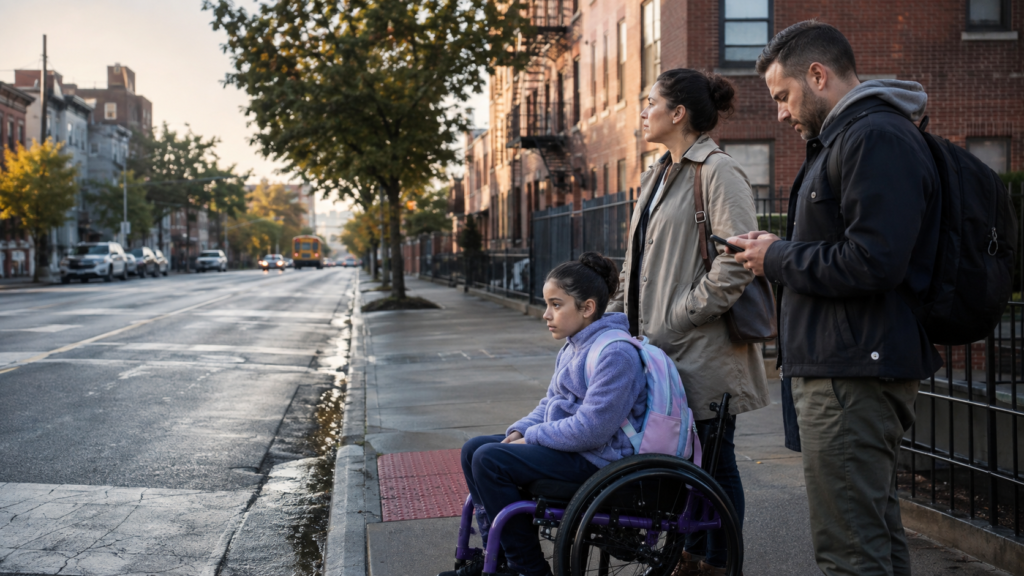
A Queens family is demanding answers after a school bus failed to collect their 11-year-old daughter with special needs on the first day of school, forcing her parents to make a lengthy drive to her school in Nassau County.
Paige Bergin, a sixth-grade student at the Henry Viscardi School, was prepared and waiting outside her Queens home on Tuesday morning. According to her family, however, the bus assigned to transport her never arrived.
With no alternative transportation provided, Paige’s parents drove her nearly an hour to school. The same journey during afternoon traffic meant that the disruption added several hours of driving to the family’s day.
Paige’s parents said the incident was particularly upsetting because their daughter had been looking forward to returning to class. They also argued that dependable transportation is essential for children with disabilities, many of whom cannot easily use conventional public transit or alternative services.
The Henry Viscardi School serves students with severe physical disabilities and provides specialized academic programs and support. Paige’s family selected the school because of the services it offers, despite the distance from their home.
When Paige and her mother eventually reached the campus, the family said they learned that they were not alone. As many as 19 students—including children who use wheelchairs and walkers or live with multiple disabilities—reportedly encountered transportation problems and had to rely on their families to reach the school.
The incident has renewed concerns about the reliability of specialized school transportation at the beginning of the academic year. Families say routes must be confirmed in advance and that parents should receive immediate updates when a bus is delayed, reassigned or unable to operate.
For parents of children with special needs, a missed bus can have consequences beyond arriving late to class. It can interrupt carefully structured routines, prevent students from receiving essential services and create serious logistical challenges for working families.
Paige’s parents are seeking an explanation for why the bus did not arrive and assurances that reliable transportation will be provided moving forward. They maintain that families should not be left to resolve failures in a service their children depend upon to access education.
The case underscores the importance of communication, accountability and contingency planning within New York’s school transportation system—particularly for students whose disabilities make dependable door-to-door service essential.