






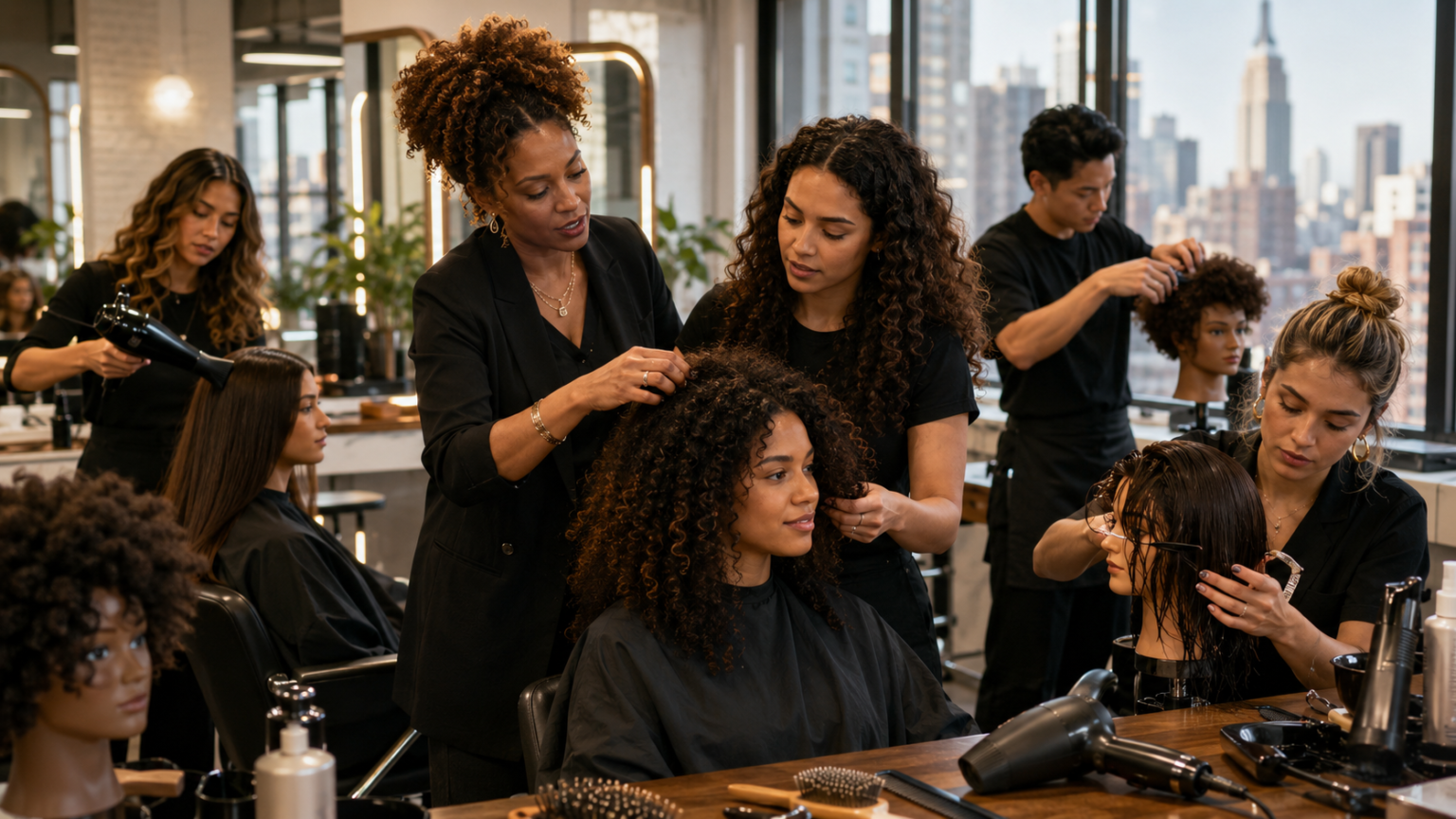
A new law has taken effect in New York requiring cosmetology students to learn how to care for and style hair across the full range of textures, from tightly coiled and curly hair to straight and fine hair.
The measure is intended to ensure that licensed professionals can serve clients regardless of their hair type. It requires cosmetology and natural-hair styling programs to incorporate broader instruction on hair texture, scalp health and appropriate treatment techniques into their curricula.
Students seeking professional licenses will also be expected to demonstrate competency in working with different hair types during their examinations. However, the total number of training hours required to qualify for a license will remain unchanged.
Supporters of the law argue that traditional beauty education has often focused disproportionately on straight or lightly textured hair. As a result, some customers—particularly Black women and people with tightly curled or coiled hair—have struggled to find salons equipped to meet their needs safely and professionally.
Inadequate training can cause more than inconvenience. Using inappropriate chemicals, heat settings or styling techniques may damage the hair and scalp, while a lack of understanding can leave customers feeling excluded from services that should be available to everyone.
The legislation was sponsored by New York Assembly Member Michaelle Solages and signed into law by Governor Kathy Hochul in 2023. Beauty schools were given a transition period to revise their courses, train instructors and obtain suitable equipment before the requirements became effective on September 1, 2026.
Under the updated standards, students will learn to recognize differences in hair structure and select suitable products, tools and treatments. The curriculum is expected to cover cutting, coloring, cleansing, conditioning and styling techniques applicable to a wider range of clients.
Advocates describe the law as both a consumer-protection measure and an important step toward inclusion in the beauty industry. They maintain that a professional cosmetology license should signify the ability to serve the public broadly—not only customers with particular hair characteristics.
The change may also create new opportunities for salons by helping newly licensed professionals serve more diverse communities. Businesses with staff trained in multiple hair textures could reach a wider customer base and reduce the need for clients to seek specialized services elsewhere.
New York follows other states that have begun updating cosmetology standards to reflect the diversity of the population. New Jersey has introduced similar requirements, signaling a broader shift toward making textured-hair education a standard part of professional beauty training.
By incorporating these skills into licensing requirements, New York officials hope to establish a more inclusive standard of care and ensure that every customer can enter a licensed salon with confidence.