
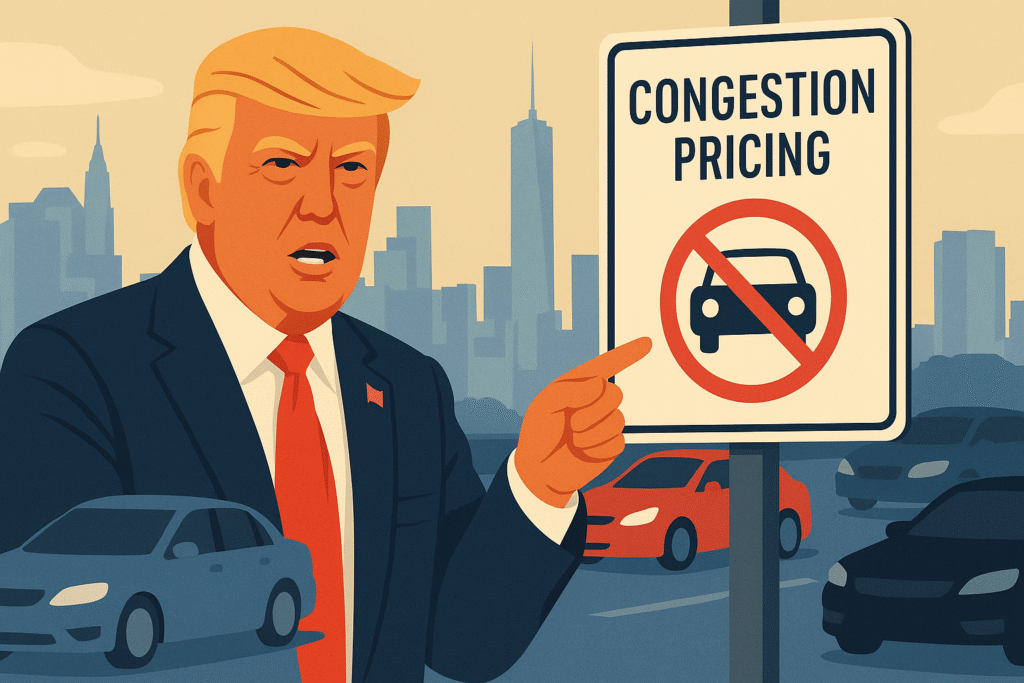
Former U.S. President Donald Trump has reignited the debate over New York City’s long-delayed congestion pricing program, pledging to cancel the initiative if he returns to the White House. The program, which would charge most vehicles entering parts of Manhattan during peak hours, aims to reduce traffic, curb emissions, and fund improvements to the city’s aging transit system — but has divided New Yorkers and become a flashpoint in national politics.
Trump’s Renewed Opposition
In remarks made Monday, Trump denounced the plan as a “disaster for working people” and vowed to eliminate it through executive action. He argued that the toll — expected to cost drivers between $9 and $23 depending on the time of day — would hurt commuters, small businesses, and middle-class families.
“This policy is a tax on the people who make New York City run,” Trump said. “It’s driving workers, truckers, and families out of Manhattan — turning it into a ghost town.”
His comments came just days before the Metropolitan Transportation Authority (MTA) is set to review the program’s latest implementation schedule. Originally approved in 2019 but delayed by political and legal challenges, congestion pricing was designed to take effect in 2025.
A Divisive Urban Policy
Supporters of the plan, including environmental groups and urban planners, argue that congestion pricing is essential for improving air quality and easing gridlock in one of the world’s most congested cities. They note that similar schemes in London, Stockholm, and Singapore have successfully reduced traffic and pollution while generating steady revenue for public transit.
“Congestion pricing isn’t just about tolls — it’s about modernizing how New York moves,” said Kathryn Wylde, president of the Partnership for New York City. “Without it, the MTA faces a funding gap that could cripple subway and bus service.”
However, critics — including Trump and several local lawmakers — view the plan as regressive and unfair. Opponents argue it disproportionately affects outer-borough residents and suburban commuters who rely on cars due to limited public transit options.
Economic and Political Repercussions
Trump’s renewed opposition has energized a growing coalition of small business owners, truck drivers, and delivery companies who fear the fees will add to operational costs already strained by inflation. The Trucking Association of New York has warned that added tolls could drive up consumer prices across the city.
Meanwhile, environmental advocates accuse Trump of politicizing a policy rooted in sustainability. “This is a short-sighted move that prioritizes populist rhetoric over climate responsibility,” said Leah Ramirez, a transportation policy analyst. “Congestion pricing is one of the most effective tools for cutting emissions in dense cities.”
Funding at Stake for Transit Upgrades
Revenue from the program — estimated at $1 billion annually — is earmarked to finance capital upgrades for the MTA, including modernizing signal systems, replacing aging subway cars, and expanding accessibility. Without it, city officials warn that essential transit projects could be delayed or canceled altogether.
New York Governor Kathy Hochul, a supporter of the plan, emphasized that the initiative is key to the city’s economic and environmental future. “We can’t build a cleaner, fairer, and more efficient city without investing in our transit system,” she said.
The Road Ahead
With Trump’s renewed opposition and lawsuits from business groups still pending, the future of congestion pricing remains uncertain. The policy has become emblematic of a broader clash between environmental reform and populist economic politics — a fight playing out far beyond New York’s borders.
As one commuter put it outside Penn Station: “Everyone agrees the city’s traffic is unbearable. The question is — who should pay the price for fixing it?”