
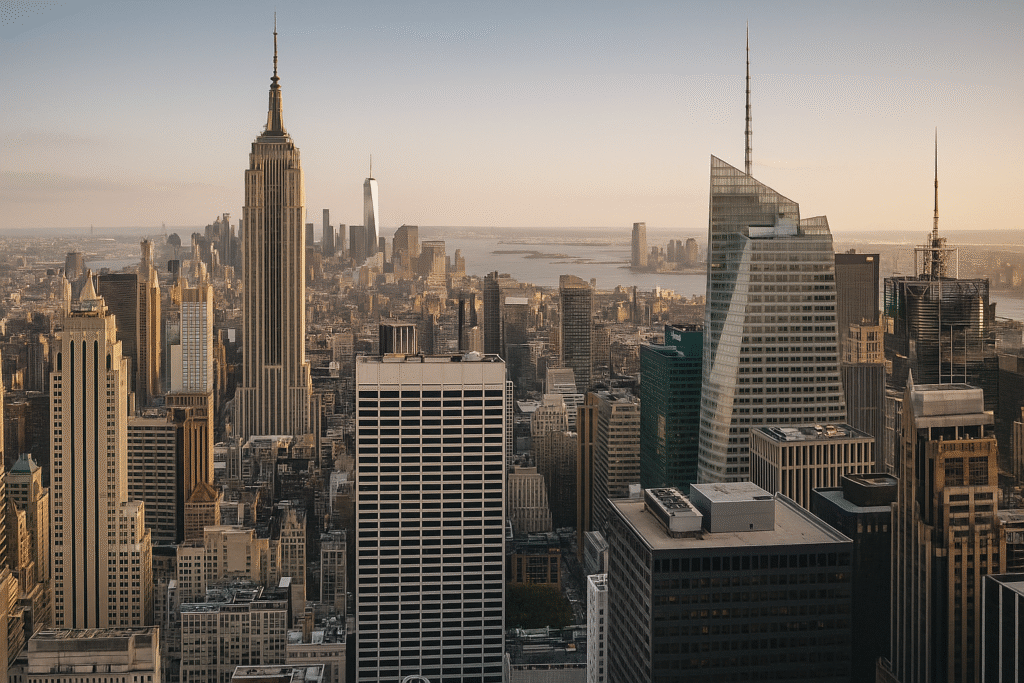
Manhattan’s commercial real estate market has shown powerful signs of revival, recording nearly $5 billion in transactions during the third quarter of 2025, according to data released by industry analysts. The surge, driven primarily by investments in office assets, marks one of the strongest quarters since the pandemic disrupted the city’s property sector.
Renewed Confidence in the Office Market
After years of uncertainty caused by remote work trends and fluctuating economic conditions, investors are signaling renewed confidence in New York’s commercial core.
Analysts note that many buyers — including institutional investors, private equity funds, and global real estate firms — are targeting Class A office spaces in Midtown and Lower Manhattan, where occupancy rates and lease renewals have started to recover.
“Manhattan’s resilience is once again on display,” said Thomas Reed, a senior market analyst at CBRE. “What we’re seeing now is a cautious but measurable comeback, especially in premium office buildings offering flexible layouts and sustainability certifications.”
A Shift in Investor Strategy
The rebound reflects a broader shift in market sentiment. Rather than avoiding office properties, investors appear to be selectively pursuing assets with strong location value and modernization potential.
Several large transactions involved properties undergoing conversion into mixed-use developments — blending office, retail, and residential components — a growing trend aimed at adapting to post-pandemic work-life patterns.
“The future of Manhattan real estate is hybrid,” said Lydia Chen, an urban economist at Columbia University. “Developers are reimagining how people live and work — and that’s changing the skyline again.”
Resilient Despite Challenges
New York continues to maintain its position as a global commercial hub, even amid higher interest rates and slower national growth. The city’s diversified economy, concentration of corporate headquarters, and recovering tourism sector have helped sustain investor appetite.
Economists view this momentum as a sign that Manhattan’s office districts — long considered symbols of the city’s economic power — may be transitioning rather than declining. Neighborhoods like Hudson Yards, Midtown East, and the Financial District are seeing increasing redevelopment interest.
Broader Implications for Urban Work Culture
The resurgence in office transactions also highlights a possible redefinition of urban work. As hybrid models stabilize, employers are seeking smaller but more technologically advanced office spaces designed for collaboration. This evolution could reshape commuting patterns, local retail demand, and the city’s post-pandemic identity.
“Manhattan’s comeback isn’t about volume — it’s about reinvention,” said Reed. “The market is adjusting to new realities rather than fighting them.”
Outlook for 2026
With continued investment momentum and potential policy incentives to convert underused buildings, experts forecast further growth into 2026. The city’s real estate board expects transaction values to climb another 8–10% by mid-next year if financing conditions remain stable.
In a world of shifting urban economies, Manhattan’s skyline once again stands as both a symbol of adaptation and enduring commercial strength.