






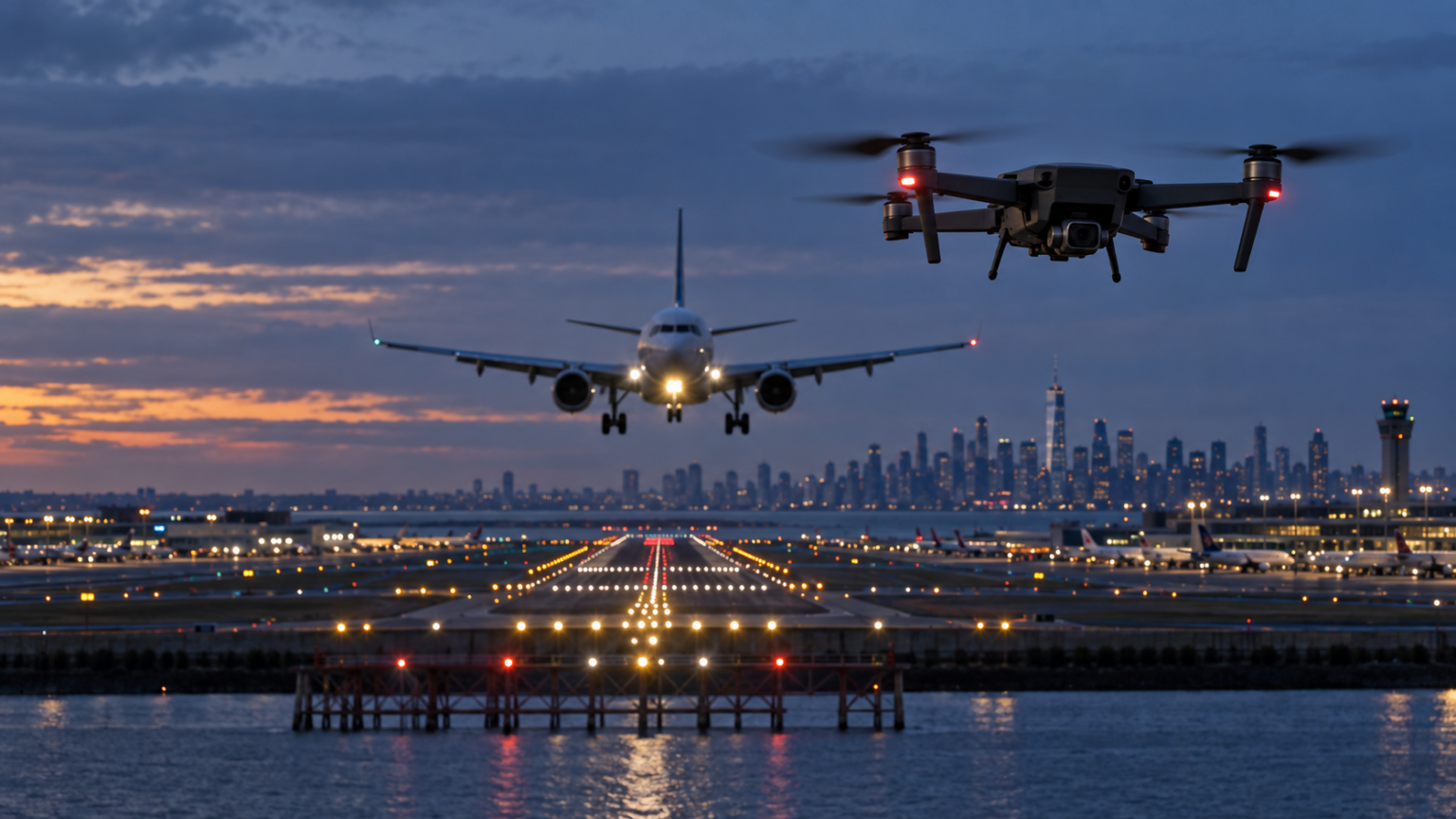
Reports of drones operating near airports across the New York metropolitan region have increased, intensifying concerns about aviation safety and the ability of authorities to identify unauthorized operators.
According to data cited by ABC7 New York, pilots and aviation personnel reported 458 possible drone sightings near airports in New York, New Jersey and Connecticut between January 2024 and June 2026. The reports involved airspace surrounding major facilities such as John F. Kennedy International Airport, LaGuardia Airport and Newark Liberty International Airport.
The Federal Aviation Administration receives more than 100 reports of suspected drones near airports nationwide each month. These incidents can force pilots to alter their approach, delay departures or take other precautionary measures to prevent a possible collision.
Concerns escalated in June when a JetBlue pilot reported striking what appeared to be a drone while approaching JFK Airport at approximately 3,000 feet. The aircraft landed safely, and a subsequent inspection found no damage or physical evidence confirming a collision. The FAA opened an investigation into the incident.
Days earlier, a United Airlines flight approaching Newark reportedly came within about 100 feet of a suspected drone. A second pilot also reported seeing an unmanned aircraft at an altitude of roughly 2,000 feet. Both planes landed safely, and no injuries were recorded.
Although such reports are treated seriously, authorities stress that not every sighting is ultimately confirmed as a drone. Pilots may encounter birds, balloons or other objects that are difficult to identify accurately while flying at high speed. Locating the operator can also be challenging because a small drone may disappear before police or aviation officials reach the area.
Federal regulations generally require recreational drones to remain below 400 feet and prohibit operators from interfering with crewed aircraft. Flights close to airports may require authorization, while violations can result in fines, criminal prosecution and confiscation of the equipment.
The expansion of recreational and commercial drone use has increased pressure on regulators to improve detection systems around airports. Officials are examining technologies capable of identifying a drone’s location, tracking its movements and tracing the signal back to its operator.
Aviation experts say stronger monitoring must be accompanied by public education and consistent enforcement. Even a small unmanned aircraft could damage a windshield, engine or other critical component if it collided with a passenger plane during takeoff or landing.
With the New York region managing some of the busiest and most complex airspace in the United States, authorities are urging drone operators to check flight restrictions and obtain the necessary authorization before taking off. The FAA continues to investigate reported encounters while warning that flying near airports without approval can place passengers, flight crews and people on the ground at serious risk.