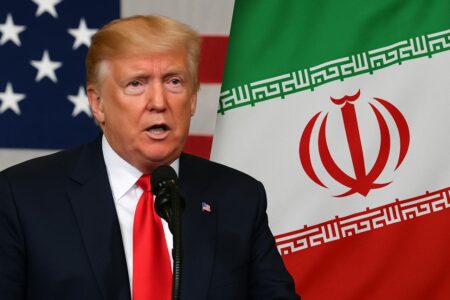





At the United Nations, Israel and Iran traded accusations on Sunday, each labeling the other as the main threat to peace in the Middle East.
Israel’s UN Ambassador Gilad Erdan asserted that Iran, whom he called the “number one global sponsor of terror,” had revealed its true face as a destabilizer of the region and the world, following Tehran’s unprecedented attack on Israel overnight. Erdan urged the Security Council to “take action,” stating that “the mask comes off and the gloves must come on.”
Erdan urged the Security Council to designate the Revolutionary Guards, Iran’s ideological army, as a terrorist organization and to impose comprehensive sanctions on Iran. He highlighted the “snapback” mechanism, allowing members of the 2015 Iran nuclear deal to reimpose international sanctions against Tehran.
Deputy US Ambassador Robert Wood emphasized the collective responsibility of Security Council members to ensure Iran’s compliance with resolutions and cessation of charter violations.
In the coming days, the United States will “explore additional measures to hold Iran accountable.”
Late Saturday, Iran launched a direct attack on its arch foe Israel for the first time, firing over 300 missiles and drones.
Nearly all intercepted by Israel, the United States, Jordan, and Britain.
Iran said its attack was in response to a deadly April 1 airstrike on Tehran’s consulate building in Syria’s capital, Damascus, widely blamed on Israel, resulting in the deaths of seven Iranian Revolutionary Guards, including two senior generals.
Addressing the emergency meeting, Iran’s UN Ambassador Amir Saeid Iravani insisted that the Islamic Republic was exercising its “inherent right to self-defense” and criticized the Security Council for failing in its duty to maintain international peace and security.
Therefore, Tehran “had no option” but to retaliate, he stated, emphasizing that his nation does “not desire escalation or conflict” but will react to any “provocation or aggression.”
He also criticized Israel, urging the Security Council to fulfill its duty and address the genuine threat to global peace and security. The council “must swiftly implement punitive actions to compel this regime to halt the genocide against the people of Gaza.”
The escalating tensions occur amid Israel’s ongoing six-month conflict with Hamas in Gaza, initiated after the Palestinian militant group’s October 7 assault in Israel, resulting in the deaths of 1,170 individuals, mostly civilians, according to an estimate based on Israeli data.
Israel’s retaliatory action has resulted in the deaths of over 33,000 individuals in Gaza, primarily women and children, according to Gaza’s Hamas-controlled health ministry.
Since the Iranian Revolution in 1979, Iran has regarded Israel as its sworn enemy, advocating for its annihilation. Historically, Tehran refrained from directly attacking Israel, and both nations opted for indirect confrontations through proxies.
UN Secretary-General Antonio Guterres called for restraint during an emergency meeting on Sunday, emphasizing that “neither the region nor the world can afford more war.”
He urged for de-escalation and defusing tensions, stressing the need to step back from the brink of conflict. Guterres reiterated his condemnation of both Iran’s strikes on Israel and the attack on Iran’s consulate in Damascus.